
At breakfast
Over toast with too much butter
Set honey is easier to control here than runny — it stays where you put it instead of sliding off the knife. Porridge and thick yoghurt take it just as well.

Red gum · Northern Victoria
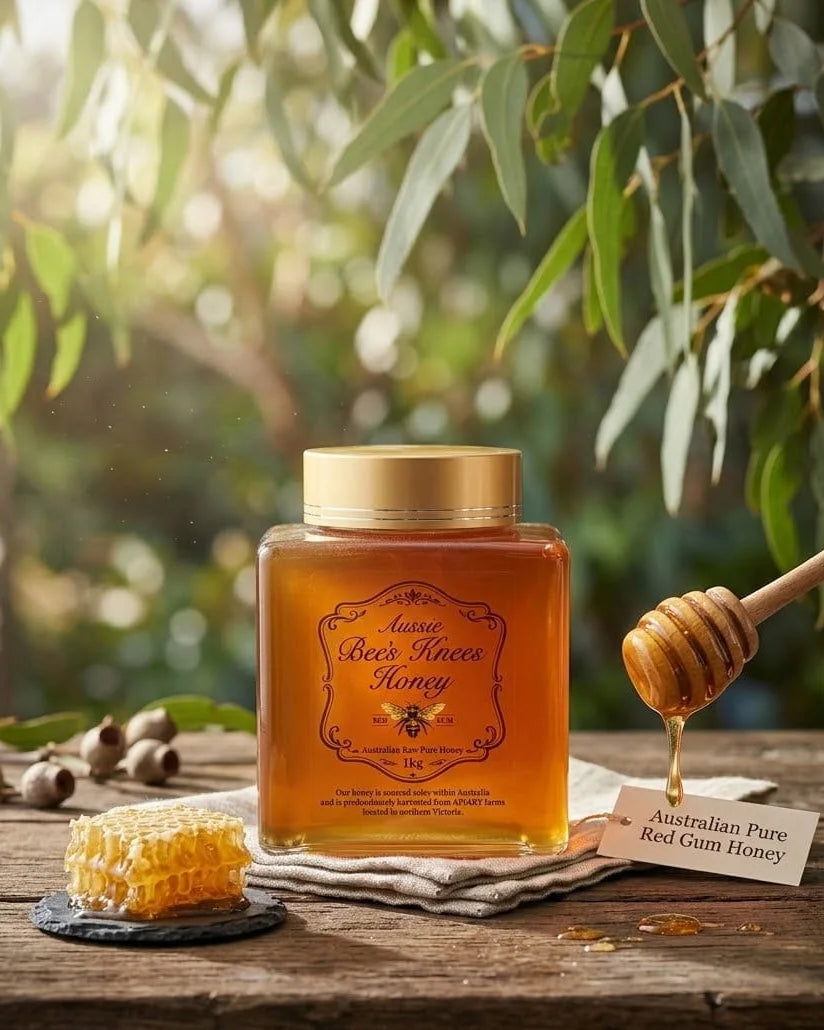
Aussie Bee's Knees is a red gum honey, sourced from apiary farms in northern Victoria and filled at 500g and 1kg. This is the long version of the label: what red gum means on a label, why the jar in your cupboard will eventually go solid, and exactly what to do when it does.

The jar
The same square glass and the same gold lid in both sizes — only the fill and the footprint change. Choose by how fast your house gets through honey, not by what you think you should buy.

For a house that uses honey a few times a week and would rather not have a jar sitting open for a year. The same honey and the same square glass as the kilo — just less of it.

The varietal
Red gum is the variety printed on the label — the eucalypt the bees were working when this honey was made. A varietal honey is named for its flower, rather than blended from whatever came in.
Naming a varietal is a statement about the source, not a promise about the taste. Eucalypt honeys are generally described as varying with the season: the same trees can give a different honey after a dry year than after a wet one.
These are the words generally used about red gum as a type. They describe the varietal, not a measurement of any particular jar, and the honey in front of you may sit to one side of them.

Country
The label says it plainly: sourced solely within Australia, and predominantly harvested from apiary farms in northern Victoria.
Eucalypts are generally described as flowering with rainfall and heat rather than on a calendar, which is why a varietal honey is a seasonal thing.
Crystallisation
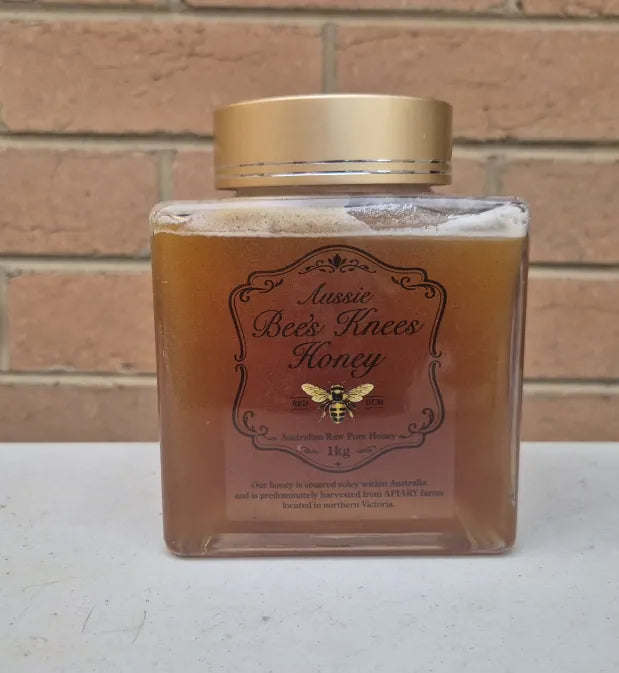
Sooner or later your jar will go pale, thick and grainy, usually from the bottom up. Nothing has gone wrong. Raw honey crystallises over time — you can see it starting in the kilo jar in our own photograph.
Honey holds more sugar than its water can really keep dissolved. Given time and a cool cupboard, some of the glucose comes back out as fine crystals. The honey has simply stopped being a liquid. Plenty of people prefer it set.
Using it
Red gum is generally described as malty rather than floral, which makes it a honey for salt, fat and heat as much as for tea. Two places to start, and three more where it quietly does the job.
At breakfast
Set honey is easier to control here than runny — it stays where you put it instead of sliding off the knife. Porridge and thick yoghurt take it just as well.

On a board
Salt and sweet is the oldest trick on a cheeseboard. Spoon it beside the blue rather than over it, so people can take as much as they want, and keep the walnuts within reach.
A glaze goes on while pastry, roast carrots or a ham are still hot, thinned with a splash of water if it has set. It catches fast under heat, so it belongs at the finish.
Let boiling water go off the boil first — honey dissolves perfectly well in a hot cup and keeps more of its character than in a scalding one.
A spoonful with vinegar, mustard and oil makes a dressing that clings. In a marinade it browns quickly, so keep it away from long, high heat.
On the table

Keeping it
Honey holds very little water, which is why it keeps far longer than almost anything else on the shelf. It will change — it darkens slowly and it sets. Neither is spoilage. The real enemies are water, direct heat and sunlight.
The short version
For anyone who reads bottom-up: the whole product in a few lines.
Questions
The ones worth answering before anyone has to ask. If yours is not here, send it to us.
Raw is a general term for honey that goes from the frame into the jar without being turned into something else on the way. It is fair to ask any producer what they mean by it — including us.
No. That is crystallisation, and it is what raw honey does. Glucose comes out of solution over time and forms fine crystals, usually starting at the base of the jar. It has just stopped being pourable.
Yes, and gently is the whole instruction. Stand the closed jar in a bowl of warm water — hand-hot, not boiling — for twenty minutes, stir with a dry spoon, and repeat with fresh warm water if it needs it. Avoid the microwave.
Red gum as a type is generally described as amber, medium to full in body, and malty or caramelled rather than floral. Those are the words used about the varietal in general, not a measurement of the jar in your hand.
It is sourced solely within Australia, and predominantly harvested from apiary farms in northern Victoria — that is what the label says.
Buy on how quickly you get through it. The 500g suits a household that uses honey a few times a week. The 1kg is for porridge every morning, regular baking, or a bench jar everyone reaches for. Both are the same honey in the same glass.
Honey of any kind is not recommended for babies under twelve months. That is standard health advice and applies to every honey, raw or otherwise.
Get in touch
A single jar, a regular order, or a question about the honey itself — say what you need and we will come back to you.